

Partner logos create trust at a glance. How do you get that trust to stick?
The difference between borrowed credibility and activated trust.

As I was grabbing a smoothie with a friend who creates ads for SaaS companies, I was chatting to her about the brand partnerships consultancy I am building. And she told me that in her work, the ads that perform best are always those that include partner logos.
Makes sense. This type of logo placement is a signal of trust at a glance. But it got me thinking about what happens next and what companies need to do to get that trust to stick.
Why partner logos work as signals
We’ve all seen the glossy partnership slide, the grid of impressive logos and the homepage with “trusted by…”
Of course, these logos usually represent real integrations. The format just compresses that relationship into a visual shorthand.
Partner logos are important credibility signals to instantly infer trust. They are shorthand for: look how credible, legitimate and reliable we are by association to these more established, known or credible companies.
You can borrow a trust signal (like a logo) for attention and initial conversion. But trust only sticks when it is backed up by real collaboration.
Trust signals get attention and help people to trust your brand faster, but they are not durable on their own. Real value happens when that partner actively supports and reinforces credibility with you over time.
The difference between a trust signal and a trust transfer
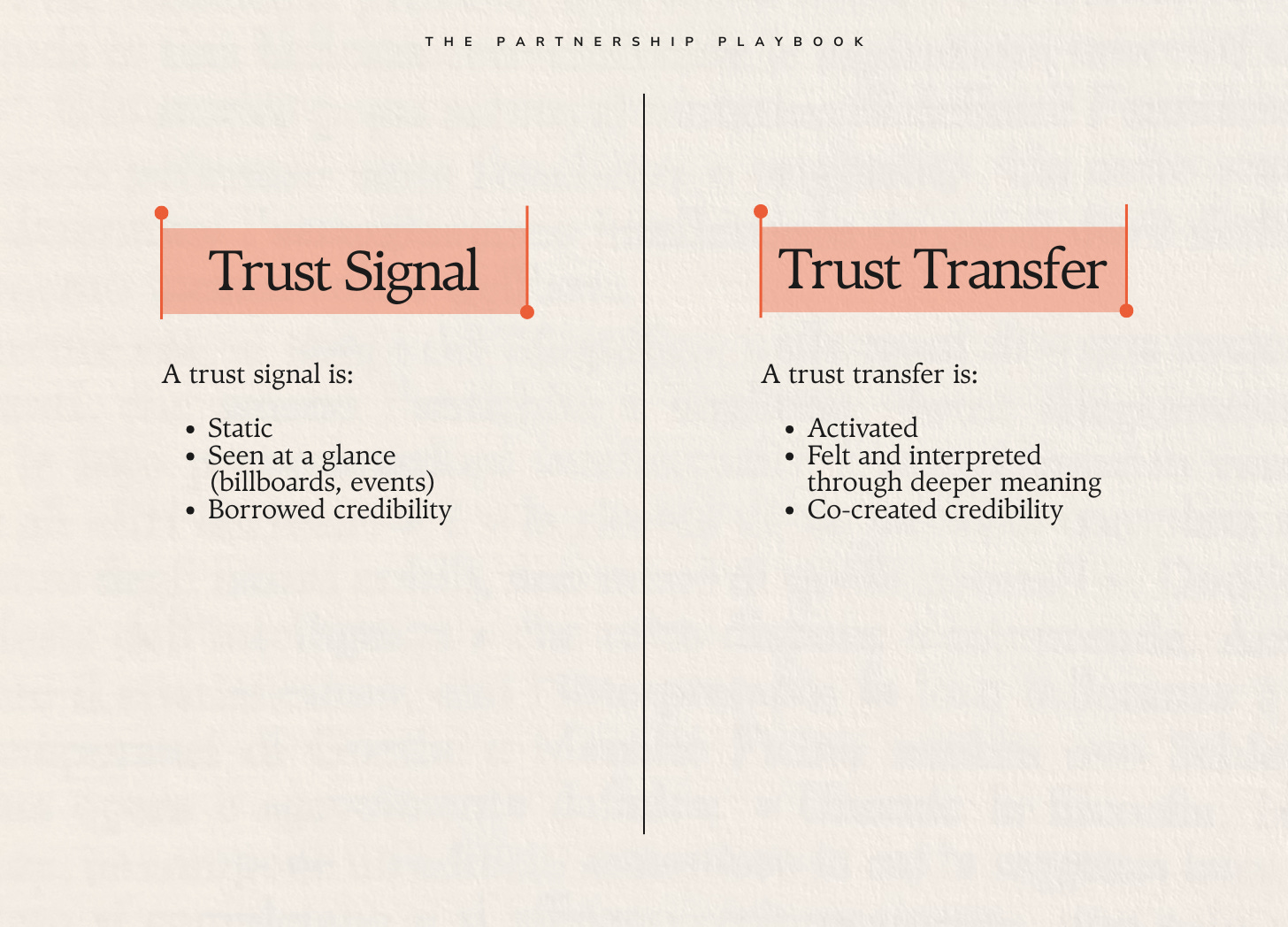
A trust signal is:
Static
Seen at a glance (billboards, event backdrop, decks, website banner, digital ad)
Borrowed credibility
A trust transfer is:
Activated
Felt and interpreted through deeper meaning
Co-created credibility + proof
How to create trust transfer in your brand partnerships
In my experience, these three conditions need to be present within your partnerships:
Alignment. The partnership reinforces shared mission and values.
Amplification. The partner actively corroborates your message.
Activation. The collaboration is systemised, not one-off.
The trust transfer system in practice
Example one: TED

It’s no surprise that 90% of TED’s audience views it as a trusted brand. The TED logo itself has become one of the most recognisable trust signals today and the kind of badge millions of professionals would love to display alongside their work.
But TED doesn’t stop at the logo. It curates partners around its mission of “ideas worth spreading,” reinforcing shared values from the start. It amplifies and distributes partner stories inside a context where audiences already trust its taste and judgement.
And importantly, TED makes partnerships repeatable across events, content, learning platforms and digital channels by embedding collaboration into a system that creates measurable, ongoing proof of co-created credibility. That’s trust transfer in action.
Example two: MasterClass

Another example I love is MasterClass Certificates, which show how a content brand can turn borrowed credibility into embedded trust.
By partnering with experts from organisations like Google X’s Moonshot Factory, Nvidia and Microsoft, MasterClass signals trusted expertise. But it doesn’t stop at showcasing big names.
Through MasterClass at Work, it integrates with learning management platforms like Degreed and builds structured learning paths that employers can track and accredit. The partnership moves from this expert is credible to this system improves outcomes inside your company.
The Takeaway
Getting a respected name to partner with you can open the door, but unless they actively stand behind your work and integrate with it, that trust won’t stick.
My advice: use partner logos to signal proof and then build the system to leverage it. The big names signal trust, but it is the infrastructure that makes it stick.
Thank you for reading The Partnership Playbook. If you would like a perspective on where your partnerships might be leaking value (or where they could compound), get in touch.